Choosing and Customizing a Bedroom
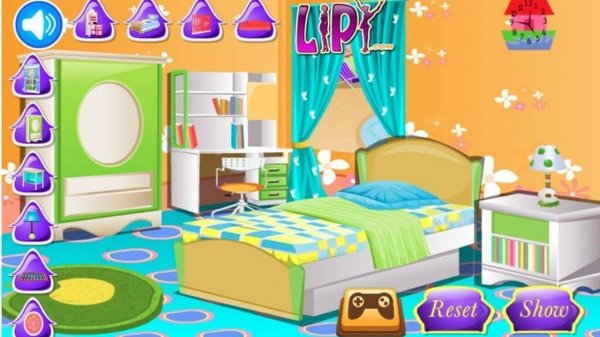
Every session starts with a template. Players select a bedroom from the available options, each one serving as a blank canvas. The initial layout is intentionally simple, which makes it easy for young designers to rearrange items or start fresh. Because the space begins uncluttered, children can focus on their own ideas rather than working around a complex pre-set design.
Simple Drag-and-Drop Controls
Using a mouse or touch screen, players move objects directly onto the scene. Furniture placement, wallpaper swaps, and decoration adjustments all happen through the same intuitive interaction. There are no nested menus or hidden settings to slow things down. This direct control lets children act on their ideas immediately, encouraging independent exploration and repeated experimentation.
Color and Pattern Play
A palette of warm tones and cool patterns gives children many ways to personalize each room. They can blend soft pastels with bright accents or try bold combinations that clash on purpose. Because colors can be changed as often as they like, the game supports trial and error without any penalty. Each new combination becomes a low-stakes experiment in visual balance and contrast.
A Stress-Free Design Space
No timers, no scores, and no penalties shape the experience. Children take as long as they want to finish a design, and they can revisit choices at any point. This relaxed structure helps build confidence, especially for kids who feel pressured by competitive games. The absence of failure states means the focus stays on imaginative play rather than performance.
Learning Through Arranging
As children place furniture and select colors, they naturally encounter basic design principles. Balance, contrast, and harmony emerge from the act of arranging and rearranging. The game does not teach these concepts through formal lessons; instead, they become part of the fun. Decorating turns into a playful learning experience that rewards curiosity and observation.
Compatibility
This H5 game runs smoothly on:
• Desktop computers (Windows / Mac) • Mobile phones (iPhone / Android)
• Tablets (iPad / Android)
🌐 Best experienced with Chrome, Safari, or Edge










Editorial Notes