Untangling Bolted Wooden Assemblies
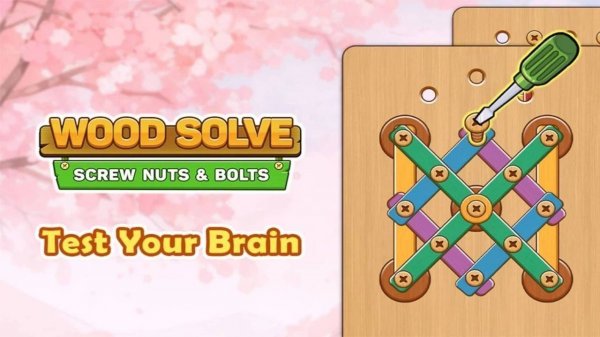
Each level in Wooden Puzzle: Assembly Challenge presents a three-dimensional wooden structure built from interlocking screws, nuts, and bolts. The objective is to remove or fasten components in the correct sequence. Because some pieces are physically blocked by others, the order of operations matters as much as identifying the right part to touch. Players must read the assembly like a mechanical diagram, tracing which bolt holds which plate and which plate traps the next bolt.
Rotating, Selecting, and Sequencing
Players rotate the puzzle using touch or mouse to inspect it from any angle, then tap a screw, nut, or bolt to select it. There are no time limits, so each move can be considered carefully. Progress comes from clearing levels of increasing difficulty, and every solved puzzle ends with a complete, correctly assembled or disassembled structure. The controls stay out of the way, keeping attention on the logic of the assembly rather than on the interface.
Why the Difficulty Curve Works
Wooden Puzzle: Assembly Challenge includes over 100 handcrafted puzzles. Early structures tend to expose their removable pieces more openly, while later ones bury key fasteners behind layers of interlocked parts. That progression teaches spatial reasoning gradually, so players build the habit of scanning for unblocked components before committing to a move. The absence of timers means the challenge comes entirely from the puzzle design, not from reaction speed.
Approaching a Stuck Puzzle
Before touching anything, examine the whole assembly and look for components that are not blocked by other pieces, since those are usually the first to remove. Rotate the view often to understand how parts relate in three dimensions. If a sequence stops working, step away briefly and return with a fresh perspective. Patience and consistency matter more than quick tapping.
Compatibility
✅ This game supports:
- Desktop browsers (Chrome, Edge, Safari)
- Mobile browsers (Chrome on Android, Safari on iOS)
❌ Does NOT support: - Internet Explorer - Very old browser versions
👉 Try refreshing or updating your browser






Editorial Notes