Two-Player Escape Format
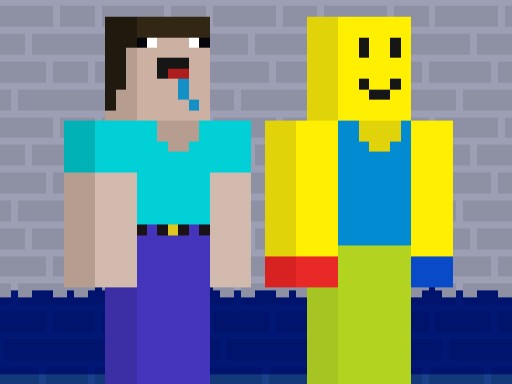
NoobLOX Rainbow Friends Arcade Run builds its entire loop around cooperation between exactly two players. Each person controls one noob character, and both must survive the same level simultaneously. The shared goal is the exit door at the end of each stage. Because the run only continues while both characters avoid the red professor, one player's mistake can end the attempt for the whole team. That structure makes communication less optional and more mechanical: calling out a gap or the professor's position is part of playing well, not just a nice habit.
Running, Jumping, and the Professor Threat
Movement is deliberately simple. Players use arrow keys or on-screen controls to run and jump over obstacles such as blocks and gaps. The challenge comes from timing and rhythm rather than complex inputs. The red professor functions as a persistent pursuer; if he touches a character, that character transforms and the run ends immediately. This turns every level into a forward-pressure scenario where stopping to think is itself a risk. Players who hesitate give the professor time to close distance, so the game rewards quick decisions and clean jump timing over cautious play.
Level Variety and Session Length
Levels are described as colorful and varied, with each one introducing new obstacles and challenges. The layouts are meant to be learned through repetition, which suits the arcade format of short, repeatable sessions. A round can fit into a break, but the cooperative structure also supports extended play as players memorize hazards and improve their coordination. The bright visuals keep the tone light even when a run fails, which makes retrying feel natural rather than punishing.
Who This Suits
The combination of simple controls, fast pacing, and mandatory teamwork points toward players who enjoy quick co-op challenges that can be picked up without a long tutorial. It is not a game about deep customization or long campaigns; it is about two people syncing their movement under time pressure. Players who like calling out hazards in real time, learning level layouts, and chasing cleaner runs will get the most from it.
✅ Compatibility & Testing
• Desktop (Windows 11, macOS Ventura)
• Mobile (iPhone 14, Samsung Galaxy S23)
• Tablet (iPad Pro, Android tablet)
✅Supported browsers: Chrome, Safari, Edge, Firefox (latest versions)
❌ Not supported: Internet Explorer, older browser versions




Editorial Notes