Building Squares, Blocking Rivals
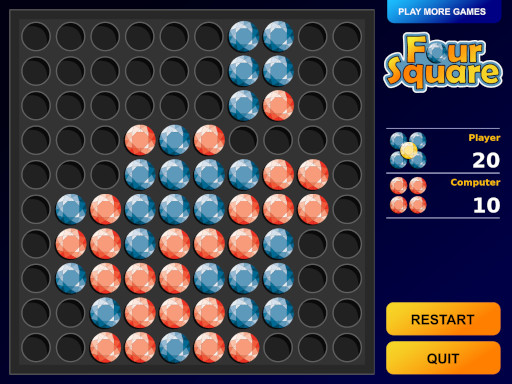
Four Square II Logic Puzzle swaps the familiar three-in-a-row goal for a four-block square. Two players alternate placing colored blocks on a shared grid. A square is complete when four of your blocks occupy its corners or form a closed shape, depending on the board layout. Each completed square adds points to your score. Because both players draw from the same board, every placement either advances your own square or interferes with your opponent's. The game ends when a player reaches a set score or when time expires, with the highest score winning.
Reading the Grid Under Pressure
Success depends on seeing two moves ahead. You want to create multiple square opportunities with a single block, forcing your opponent to choose which threat to block. At the same time, you must spot their emerging formations and cut them off before they close. The board changes quickly, so pattern recognition matters more than raw speed. Players who scan the whole grid rather than fixating on one corner tend to find better defensive moves. [IMG_1]
Who This Puzzle Suits
The rules take a minute to learn, but the strategic layer keeps matches tense. Families can play together because the concept is visual and language-independent. Competitive players will appreciate the back-and-forth of blocking and counter-blocking. Short sessions work well, yet the depth supports longer play. If you enjoy games like tic-tac-toe but want more decision-making per turn, this grid-based logic puzzle offers that step up without adding complex rules.
Compatibility
✅ Works on PC & Mobile | Recommended: Chrome / Safari / Edge










Editorial Notes